The Opening Scene Sets the Terms of a Film
Learn how a film’s opening scene signals tone and viewpoint, helping you settle into an unfamiliar story without mistaking deliberate uncertainty for confusion.
A film’s opening scene can change how you watch the next one. A door left ajar, a joke delivered without a smile or a conversation heard from another room gives you something concrete to follow before the plot has explained itself. The opening scene is not a miniature version of the whole film; it is the first chance to see how this particular film arranges your attention.
That is useful when you have picked an unfamiliar title for a cinema visit or a night at home. Rather than grading the film before the story has begun, notice its opening choices: what it shows clearly, what it holds back and how it makes an ordinary detail feel worth watching. Those choices can shift as the film develops, but they give you a place to start.
What can an opening scene tell you?
An opening may introduce a person, a place, a problem or a combination of all three. A hand struggling with a key makes the action immediate; a wide view of a deserted station makes the setting hard to ignore. Neither image explains the plot. Each gives the scene a different centre of gravity.
Some films begin with an unanswered question: why is someone ignoring a ringing phone, or what lies beyond the frame? Others let a small action unfold without explaining its importance. You can notice those choices without trying to solve them. The film may provide context later, or keep the detail modest.
Think of the first scene as a cinema ticket rather than a map: it gets you into the experience, but does not show every turn ahead. A name, place or unusual event may only become clear after the opening. In the meantime, the framing, sound and pace can make the scene legible as an experience, even when the plot remains open.
How does an opening scene establish tone?
Tone is the way a film treats its material: with playfulness, unease, tenderness, severity or a mixture that is harder to label. It emerges from the relationship between performance, music, editing and setting. A frightening event played in a flat, matter-of-fact manner creates a different impression from the same event punctuated by a sudden musical sting.
One cue on its own rarely settles the matter. Bright colours can sit alongside a bleak exchange; a quiet opening can be followed by sharp comedy. A character might speak gently while the camera holds on an empty doorway, making the calm feel strained. Notice how the choices interact instead of treating any single one as a promise about the whole film.
Timing matters, too. Quick cuts and overlapping voices can suggest hurry, bustle or comic confusion. A sustained shot may leave room to inspect a face, or make an ordinary room feel uncomfortable. Ask whether the film is moving you swiftly towards the next event or giving a moment space to linger.
Whose experience shapes what you see?
A character does not need to narrate for a film to bring you close to them. The camera can stay with someone as they cross a crowded street, showing you only what they encounter. Or it can hold back, observing a room without access to anyone’s private thoughts. The opening may establish that distance before you know enough to describe it.
Notice who seems to know what. If you follow a person through a market but never see what they are searching for, the scene may keep you near their uncertainty. If the film cuts to an empty staircase while the characters remain elsewhere, it gives you information beyond theirs, perhaps to build unease.
Sound also controls access. Clear dialogue against a noisy café can make one exchange feel singled out; a muffled announcement can leave you as unsure as the person listening. When a face, reply or view is withheld, note the effect without deciding immediately whether the gap belongs to a character’s limited knowledge or the film’s wider design.
How can you read an opening scene without guessing too much?
Separate what you can see from what you think it means. “The camera stays on the locked door” is an observation. “Someone is trapped” is one possible interpretation, not yet a fact. Keeping the two apart lets you stay curious without turning every object into a prediction.
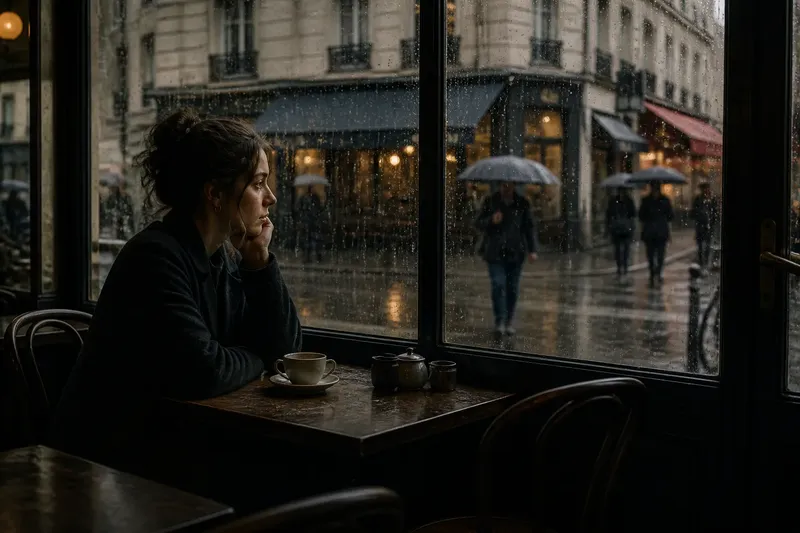
Say you begin an unfamiliar film with a woman alone in a café while rain taps at the window. She leaves her tea untouched; the scene then holds on the door as footsteps pass outside. You note the restrained pace, the focus on her and the attention given to the entrance. You do not know whether she expects someone, hopes they will stay away or is simply watching the street. Later scenes may clarify the situation, change your reading or leave it unresolved.
One small question is often enough: what does this scene ask me to notice? It might be a sound that returns, a mismatch between a smile and a line of dialogue, or a person’s response to something everyone else ignores. Keep the answer provisional. Films are allowed to revise the terms they began with.
Which details matter before the plot becomes clear?
When the story is still taking shape, these details can help you follow the scene without trying to decode every choice:
- Framing: Check whether the camera favours close faces, distant figures, empty space or objects between people. If faces dominate, follow reactions; if empty space or barriers take over, watch how characters move through or around them.
- Sound: Check which sounds sit clearly in the foreground and which fade into the room. If a repeated noise draws attention, listen for its next appearance; if ordinary room sound dominates, use voices and movement to follow the scene.
- Editing: Check whether the film stays with a moment or cuts away quickly. If it lingers, use the time to notice gestures and surroundings; if it cuts rapidly, follow the action across the changing shots rather than settling on one image.
- Dialogue: Check for pauses, evasions and changes of subject as well as explanations. If a character avoids a question, note the exchange and wait for more context; if they speak plainly, follow the information they provide without assuming it resolves the larger story.
- Repetition: Check whether a gesture, colour or object returns. If it recurs, remember where it appeared and see how its context changes; if it does not return, let it remain part of that scene instead of forcing a hidden meaning.
- Performance: Check how a character’s expression and delivery relate to their words. If they conflict, attend to the tension between them; if they match, take the exchange at face value until another scene gives you reason to reconsider.
These details are most useful in combination. Imagine a hypothetical opening with a long, quiet shot: an open doorway and ordinary room sounds may make the pause feel peaceful, while a figure held at the edge of the frame and a faint recurring scrape may make the same pause uneasy. Neither arrangement tells you what will happen. Each gives you a different way to experience the moment.
What do readers often wonder about an opening scene?
Does an opening scene explain the whole plot?
Usually, it introduces a situation or a way of seeing rather than laying out the entire story. A film may leave motives, relationships or stakes unclear so that later scenes can supply the context.
Can a film’s tone change after its opening?
Yes. A film can move gradually from one register to another or shift abruptly after an early scene. Treat the opening as an initial impression, not a rule for everything that follows.
What if I do not understand the first scene?
Start with what is plainly present: the people, place, sounds and actions. A detail may become clearer later, and a little uncertainty does not mean you have missed something essential.
Should I read an explanation before watching?
A synopsis can help you decide whether a film suits your evening or check for material you would rather avoid. If you want the opening to work on its own terms, leave detailed interpretations until afterwards.
When can an opening’s direction change?
Some films begin by encouraging an expectation they later complicate. An apparently conventional romance may develop a sharper comic edge; an event that seems central may turn out to be a brief way into another story. Such a shift can make you reconsider the first scene rather than discard it.
When the film changes its use of music, camera distance or editing, ask whether the story has changed direction or your understanding has caught up. You do not need to predict a twist. Staying open to a new pattern is enough.
A film may also return to an image or sound from its opening. By then, you know more about the people and events around it, so the detail can carry a different emotional weight. The scene is unchanged; what has changed is the context you bring back to it.
How can the first scene help you settle into an unfamiliar film?
Give the opening room to establish its pace. Follow the immediate action, notice one choice about tone and one detail that catches your eye, and let unanswered questions wait. At home, that might mean not interrupting the scene to look up a name; in a cinema, it may mean simply listening before deciding what kind of film you are watching.
The opening scene offers a starting point, not a verdict. If you searched for how an opening scene sets a film’s terms, the practical answer is to notice what the film emphasises, keep observations distinct from guesses, and allow later scenes to alter your first reading. A door, a pause or a stray sound may become important, or may simply belong to the moment where you first encountered it.